Best Talent Assessment Platforms in 2025: Features, Benefits, and How to Choose
In 2025, recruiters are navigating a hiring landscape unlike anything before. AI-enabled candidates are flooding the pipeline, making it harder than ever to distinguish genuine talent from algorithmically optimised applicants. With job applications skyrocketing and AI-generated resumes perfectly tailored to keyword scans, recruiters must stay one step ahead with smarter assessment tools to ensure quality hires that drive business success.
But this comes at a time when recruitment teams are leaner than ever before (LinkedIn).
The average recruiter today juggles 56% more job requisitions (14 per recruiter) and 2.7× more applications (over 2,500 per role) than just three years ago, intensifying the challenge of finding the right talent amidst an influx of AI-optimised applications.
Resourcing leaders are under intense scrutiny in the boardroom as businesses rebound and shift focus toward expansion. With attrition rates climbing and hiring ROI now a top-line business concern, the pressure is on recruiters to deliver quality hires that stick. The era of reactive hiring is over—leaders need data-driven, strategic talent acquisition that aligns with business growth. This is where Talent Assessment Platforms are becoming mission-critical, helping organisations move beyond gut feel to predictive hiring decisions that drive workforce stability and performance.
These platforms go beyond resume screening to evaluate real-world job readiness, ensuring organisations hire for skills, cultural fit, and long-term success. In this guide, we explore the latest trends, must-have features, and the best Talent Assessment Platforms of 2025 to help you stay ahead of the hiring curve.
Key takeaways:
- Attrition is a business crisis. Companies can’t afford bad hires in 2025.
- Context matters more than skills. Job realism is replacing one-size-fits-all skills tests.
- AI-powered screening is under scrutiny. Many HR teams are reconsidering its role.
- Recruitment KPIs are changing. Quality over quantity, retention over speed.
What is a Talent Assessment Platform?
A talent assessment platform is a tool or software designed to evaluate the fit of potential candidates. It helps organizations identify and assess the talent in their workforce or during the hiring process.
These platforms typically provide a range of assessments, such as:
- Skill-based tests: Evaluating specific technical or soft skills.
- Personality tests: Understanding behavioral traits, work preferences, and how candidates might fit within a team.
- Cognitive ability tests: Measuring problem-solving, logical reasoning, and critical thinking skills.
- Job simulations: Providing realistic scenarios to see how candidates respond in real-world job-related situations.
- Psychometric assessments: Evaluating attitudes, emotional intelligence, and cognitive abilities.
The goal of a talent assessment platform is to help employers make data-driven decisions by gaining a clearer understanding of a candidate’s or employee’s capabilities, ensuring they match the right people with the right roles, and promoting better overall performance within the organisation.
Why are Talent Assessment Platforms essential?
- 78% of HR leaders report improved hire quality with assessments (SHRM).
- Companies using Talent Assessment Platforms experience a 39% lower turnover rate (Aberdeen).
- Hiring managers who use pre-hire assessments report 36% higher satisfaction with hiring outcomes.
The benefits of Talent Assessment Platforms
How Talent Assessment Platforms should drive hiring success:
- Data-Driven Accuracy – Reduces gut-feel hiring errors.
- Bias Reduction – Ensures fairer hiring decisions.
- Faster Time-to-Hire – Cuts manual screening time significantly.
- Lower Cost Per Hire – Reduces wasted spend on mis-hires.
- Higher Retention Rates – Employees stay longer when well-matched.
- Improved Cultural Fit – Aligns candidates with company values.
- Predictive Hiring Insights – Forecasts long-term job performance.
To AI or not to AI?
The AI dilemma in Talent Assessment technology
Demand for AI-powered Talent Assessment tools surged in 2024, but many failed to demonstrate real value (Read the report here). Now, 9% of HR leaders are moving away from AI solutions, citing bias risks, compliance concerns, and lack of measurable impact.
Key considerations for AI-driven platforms:
- What are the risks?
- Has it been validated?
- Does it provide hiring ROI?
- Is it compliant with hiring regulations?
- Does it improve decision-making?
Top Talent Assessment Platform Features for 2025
The Industry Shift: What’s Trending Now?
HR teams are prioritizing job realism, predictive analytics, and candidate-centric experiences.
? Role-Specific Hiring – Moving beyond generic skill tests to real-world, contextually relevant assessments.
? Realistic Job Previews – Candidates experience the role before getting hired.
? Smarter AI – AI must provide tangible value, not just automate rejection.
Must-Have Features:
✅ Customisation– Job-specific assessment tools.
✅ ATS Compatibility – Seamless workflow integration.
✅ Predictive Hiring Analytics – Data insights for smarter hiring decisions.
The Best Talent Assessment Platforms in 2025
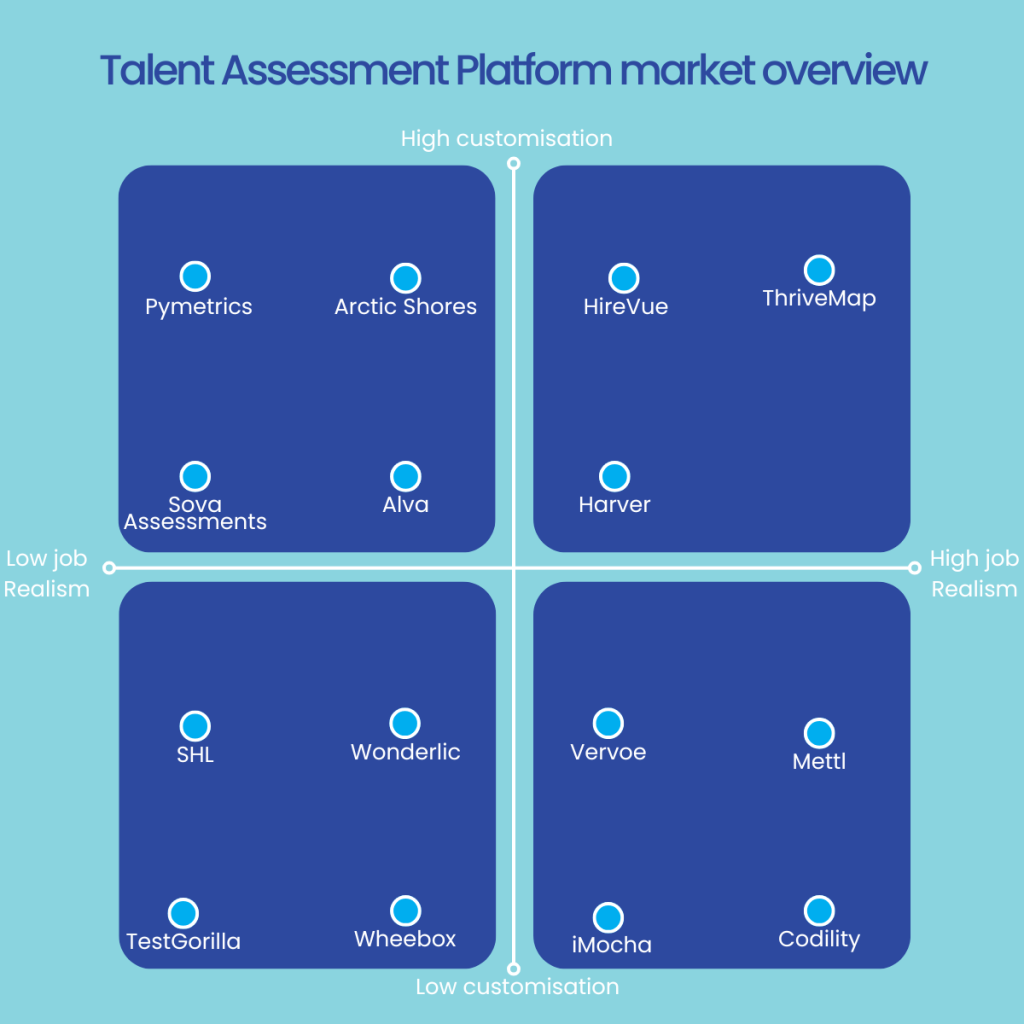
Market Comparison Matrix
? High Customization, High Job Realism (Best for role-specific hiring)
- ThriveMap – Realistic job assessments tailored to actual tasks.
- HireVue– Simulated job tasks with AI-driven evaluation.
- Harver – AI-driven cognitive and skills-based assessments.
? High Customization, Low Job Realism (Customizable, but lacks real-world tasks)
- Pymetrics – AI-driven behavioral assessments.
- Sova Assessments – Cognitive/psychometric assessments with customization.
- Arctic Shores – Gamified, neuroscience-based assessments.
- Alva – AIiven personality and logic evaluations.
? Low Customization, High Job Realism (Pre-built, realistic job simulations)
- Vervoe – Off-the-shelf job simulations.
- iMocha – Remote-based skills testing.
- Codility – Technical skills testing.
- Mettl – Online assessments and learning tools.
⚠️ Low Customization, Low Job Realism (Generic, one-size-fits-all)
- SHL – Standardized cognitive/personality tests.
- Wonderlic – Broad cognitive testing.
- TestGorilla – Off-the-shelf skills tests.
- Predictive Index – Psychometric assessments with behavioral insights.
- Wheebox – Psychometric, cognitive, and technical assessments.
How to Choose a Talent Assessment Platform
Key Considerations for HR Leaders
- Define Hiring Objectives – Do you need high-volume screening or role-specific insights?
- Evaluate AI Features – AI should enhance hiring, not complicate it.
- Balance Customization & Standardization – Choose based on hiring scale and complexity.
- Prioritize Candidate Experience – Gamification is declining; job realism is key.
- ATS Integration – Ensure smooth adoption into your existing tech stack.
- Data & Analytics – Leverage insights to continuously refine hiring strategy.
Ready to invest in a future-proof talent assessment tool?
2025 isn’t the year for guesswork. With AI-optimized resumes flooding your inbox and hiring expectations higher than ever, ai-proof talent assessment platforms aren’t just useful—they’re essential. The best hires don’t come from gut feel or generic tests; they come from real-world, job-specific insights that predict success before day one.
Move beyond outdated assessments and start hiring with confidence with ThriveMap’s Realistic Job Assessments can help. See how it works—book a demo today.

Keep reading.
Choosing a pre-hire assessment provider: what the new RecTech standard asks of them
UK RecTech vendors process more than 200 million job applications between them a year (Better Hiring Institute). That is the scale of what is riding on these tools actually working: whether the right people get shortlisted, and whether good candidates get screened out by something nobody has ever checked. The pressure on that volume is […]
How to avoid contrast bias in recruitment
Imagine your team spends a day sifting CVs. The first few are underwhelming. Then they open one that’s reasonably strong and, by comparison, it looks excellent. Or you’re interviewing six candidates in a day. The 10am candidate gives polished, detailed answers and sets an unusually high bar. The person who follows is perfectly capable, but […]
If AI can pass your hiring process, what are you actually assessing? Join live Equitas, ThriveMap and Morgan Philips Webinar
AI is changing both sides of recruitment at the same time. Candidates can use it to write CVs, improve applications, prepare interview answers and increasingly automate the application process itself. Employers are using AI to screen candidates, match people to roles and automate parts of selection. Some of this technology is genuinely useful. Some of […]