Why “Fairer” Hiring Still Fails to Deliver Better Outcomes
There’s a growing belief in hiring:
? AI will solve bias.
And on the surface, that’s happening.
AI screening tools can:
- Review every application
- Apply consistent criteria
- Reduce human subjectivity
Compared to manual CV screening, that’s a clear step forward.
But focusing only on bias misses a bigger issue.
? Because even if hiring becomes fairer, it still isn’t becoming more accurate.
The real problem with AI in recruitment
Most discussions around AI in hiring focus on one question:
? Is it fair?
But very few ask:
? Is it actually helping hire the right people?
The data suggests otherwise.
A survey of 1,000 candidates found:
- 72% said the job they accepted wasn’t what they expected
- 66% left a role because of that mismatch
At the same time, organisations are investing heavily in hiring technology — with average spending on assessments reaching £136,000 per year.
Despite this:
? People are still joining roles that don’t match their expectations— and leaving.
So the issue isn’t just bias.
It’s accuracy.
AI screening reduces bias — but doesn’t fix the inputs
AI screening tools work by applying rules to existing information:
- CVs
- Job descriptions
- Assessment criteria
The problem is:
? those inputs are often flawed.
Hiring processes frequently:
- Oversell the role
- Simplify the day-to-day work
- Focus on ideal traits rather than actual tasks
So even if AI evaluates candidates fairly…
? it’s still evaluating them against an inaccurate picture of the role.
The data even shows candidates feel the information they receive throughout the hiring process is, overall, consistent.
? Which suggests the problem isn’t inconsistency.
It’s that the hiring process is consistently built around an incomplete or inaccurate version of the role.
You can remove bias and still make the wrong hire
This is where most hiring strategies fall down.
Improving fairness doesn’t guarantee better outcomes.
Because hiring decisions are still being made without candidates fully understanding what the job involves.
The result:
- Candidates accept roles based on incomplete information
- Expectations don’t match reality
- Early attrition increases
This is not a bias problem.
? It’s an expectation gap.
Why candidates leave (and it’s not what most teams think)
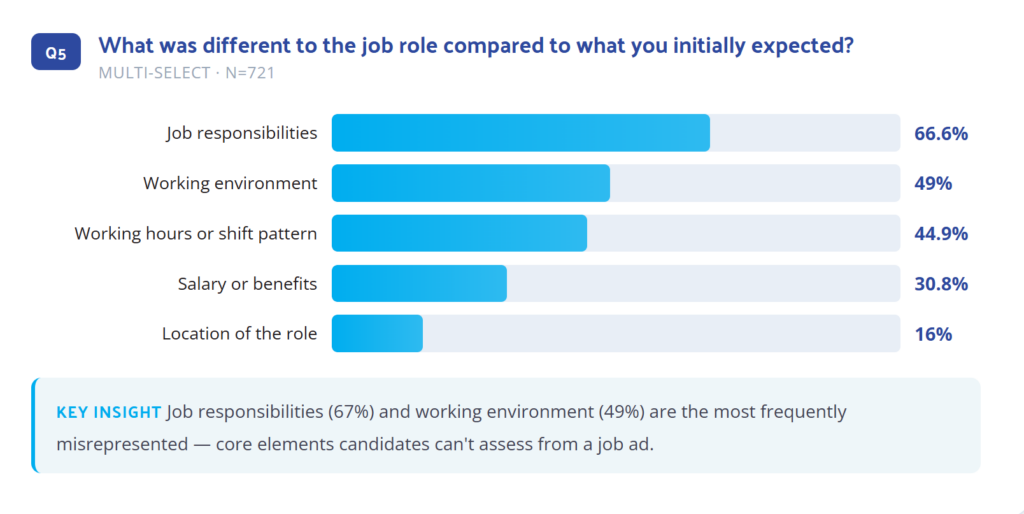
When candidates leave roles early, the reasons are consistent:
- 66.6% say the job responsibilities were different from expected
- 49% cite the working environment
- 44.9% mention working hours or shift patterns
- 30.8% highlight salary or benefits
These are not issues AI screening is designed to solve.
? Because they happen after the hiring decision has already been made.
A practical example
A company hires for a “consultative sales” role.
The reality:
- the reality looks different.
- Reps are expected to make calls outside standard working hours
- Evenings and weekends are often where the best contact rates happen
- Performance is heavily tied to call volume and persistence
- Rejection is constant
None of this is clearly surfaced during the hiring process.
AI screening might fairly identify the most capable candidates.
? But it doesn’t show them what the job actually feels like.
So candidates accept the role expecting one thing…
…and experience something very different.
? That’s when they leave.
Not because they couldn’t do the job.
Because they didn’t sign up for that version of it.
AI is solving the wrong problem
Most AI hiring tools are designed to improve:
- Screening speed
- Candidate filtering
- Shortlisting accuracy
All useful improvements.
But they are built around one assumption:
? The goal is to select the best candidate.
That assumption is flawed.
Because hiring doesn’t usually fail at selection.
? It fails in what happens next.
The shift hiring teams need to make
To fix this, hiring needs to move beyond selection.
From:
? Who is the best candidate?
To:
? Should this person take this job — knowing exactly what it involves?
This shift changes everything.
Instead of focusing only on fairness and filtering, hiring should focus more on alignment between candidate expectations and reality
Final thought
AI is making hiring fairer.
But fairness alone doesn’t solve hiring.
If candidates don’t understand the job before they accept it:
? they will continue to leave — regardless of how fair the process is.
And if your hiring system produces hires who don’t stay:
? it’s not working.
It’s just failing … more efficiently.