How ThriveMap’s new reasonable adjustments feature is setting a new benchmark for inclusive hiring
Fear, unfair practices, and a lack of transparency – these are just a few of the reasons candidates with disabilities often hesitate to apply for jobs. Despite increased awareness around workplace diversity and inclusion, the recruitment process itself remains a significant barrier for many.
Few assessment platforms offer clear pathways for reasonable adjustments, and even fewer actively flag those needs to recruiters. At the same time, a significant majority of candidates with disabilities report that they’ve abandoned job applications due to inflexible or inaccessible assessments.
At ThriveMap, we believe it’s time this changed.
“Inclusive hiring shouldn’t start at the interview – it should start from the first click,” says Chris Platts, CEO at ThriveMap. “Our new reasonable adjustments feature makes it easy for candidates to ask for what they need, and for employers to meet them with fairness.”
A feature designed for fairness
ThriveMap’s latest update introduces an intuitive way for candidates to request reasonable adjustments directly within the assessment process. Whether it’s additional time, alternative formats, or other accessibility needs, candidates can now select from a short, supportive form tailored to the most common barriers: dyslexia, visual impairment, anxiety, and more.
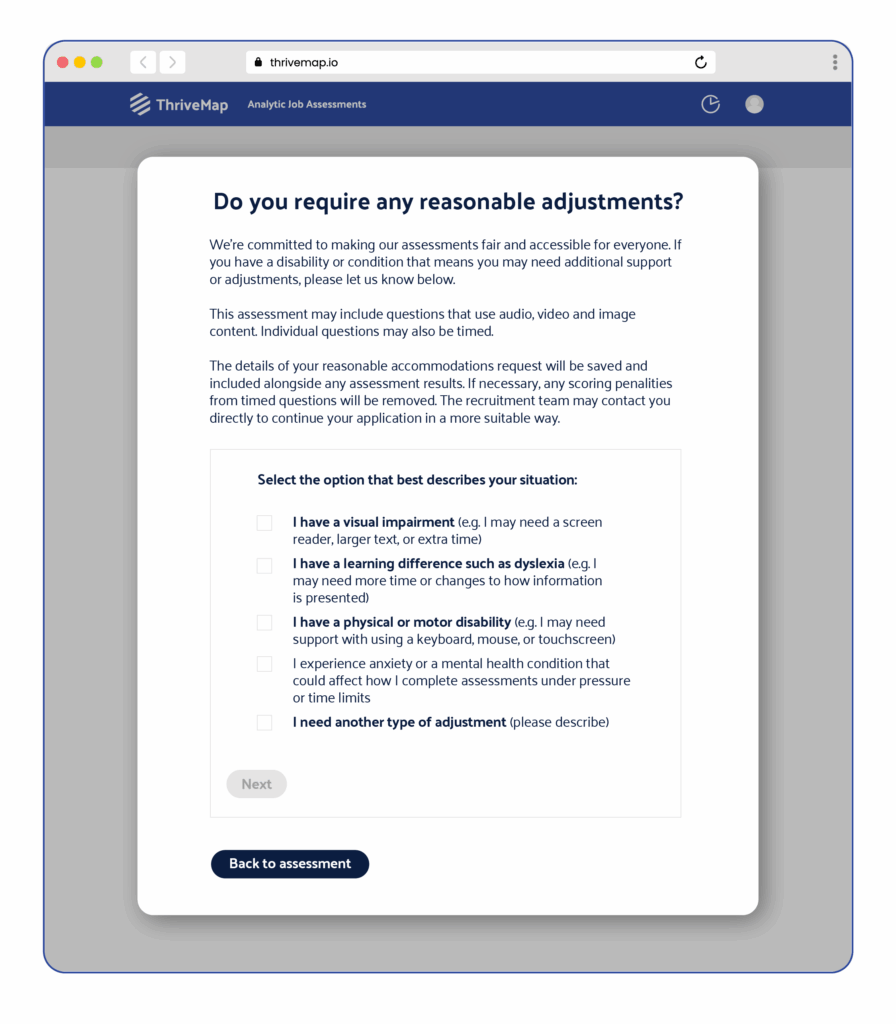
These needs aren’t just captured; they’re clearly flagged on the recruiter’s report, allowing hiring teams to adapt their approach and remove any time penalties or unfair scoring biases.
An optional graphic prompt shows the impact: the assessment dashboard updates in real time, helping recruiters make informed, compassionate decisions. It’s a small interaction with a big message: you are seen, and you are supported.
Why this matters
Hiring assessments are often positioned as “objective”, but objectivity is meaningless without accessibility. Many platforms today still treat all candidates the same, assuming that equality is synonymous with fairness.
But as disability advocates know, fairness means meeting people where they are, not pretending we’re all starting from the same place.
ThriveMap’s assessments already support a range of candidate experiences – including visual and audio formats, clear and uncluttered UI, and mobile-friendly interfaces. This new feature builds on that foundation, making it easier than ever for candidates to take part fully and confidently.
“Too many candidates are self-eliminating from roles they’re perfectly capable of succeeding in, simply because the process wasn’t built with them in mind,” says Platts. “We wanted to fix that.”
A new standard in assessment
The addition of reasonable adjustments isn’t just a ‘nice to have’ – it’s becoming a baseline expectation. Inclusive assessment practices are not only better for candidates but also better for business.
According to the UK government, employers who embrace inclusive practices see 28% higher revenue per employee and improved staff retention(https://www.accenture.com/content/dam/accenture/final/a-com-migration/pdf/pdf-89/accenture-disability-inclusion-research-report.pdf). Accessible assessments widen the talent pool, improve candidate experience, and reinforce employer brand.
Yet, despite these benefits, only a small fraction of recruitment tools actively support custom adjustments. ThriveMap is proud to be among the first assessment providers to not just talk about inclusivity, but build it into the core of the product.
What’s next?
As hiring continues to evolve, tools like ThriveMap are leading the charge toward a more human, more accessible future. Reasonable adjustments shouldn’t be an afterthought – they should be a default option.
By creating space for transparency, flexibility and fairness, ThriveMap’s new feature helps employers unlock the true potential of every candidate.
Want to learn more?
Explore how ThriveMap’s assessments help your team hire fairly, inclusively and confidently – right from the start.
Get started here: https://review-mkt.thrivemap.com/get-started-now/
Keep reading.
Diversity Training: 5 Alternatives to Bias Training
Attitudes to diversity are changing. #BlackLivesMatter is a movement, not a moment. And it’s put recruitment and recruiter bias firmly in the spotlight. Talent Acquisition leaders across the world are desperately seeking to ascertain whether their hiring practices are fair and inclusive. A range of diversity-friendly tools and training programs are here to help, but […]
The 13 Areas of Diversity Every Recruiter Needs to Know
Diversity is often a buzzword many companies use to promote their recruitment campaigns and employer branding strategies. At the same time, the hunt for diversity, first and foremost, leans toward racial diversity. Many businesses believe they have diverse teams if they are diverse in the colour of people’s skin. Incorrect. Diversity does not stop at […]
How to Hire for Culture Fit Without Harming Diversity
Culture fit is somewhat of an HR buzzword right now, with hundreds and thousands of articles being written about it’s importance each year. This is not one of them.