Looking to improve your candidate experience? You’re in the right place.
Three example best practices to elevate your candidate experience
In this article, we’ve compiled three “best practice” examples implemented by hiring teams to improve candidate experience.
But first, we’ll define what candidate experience is and explore its significance in achieving a well-oiled recruitment machine. Let’s go.
What is candidate experience, and why does it matter in high-volume recruitment?
Most recruiters are measured on metrics like cost per hire, time to hire, and quality of hire. Candidate experience is often overlooked. However, organizations with a superior candidate experience enjoy long-term benefits, including:
- 1. Attracting more candidates to apply for positions.
- 2. Better offer acceptance rates, even if the salary is less than a competitor because the organisation has demonstrated genuine care throughout the recruitment journey.
- 3. Preventing candidates, as your potential customers, from boycotting your brand or negatively influencing the purchasing decisions of others.
So, who are your candidates? A person becomes a candidate when they express formal interest in a job opening – whether they meet your hiring criteria or not. At this point, they become a part of a stakeholder group that needs varying levels of care.
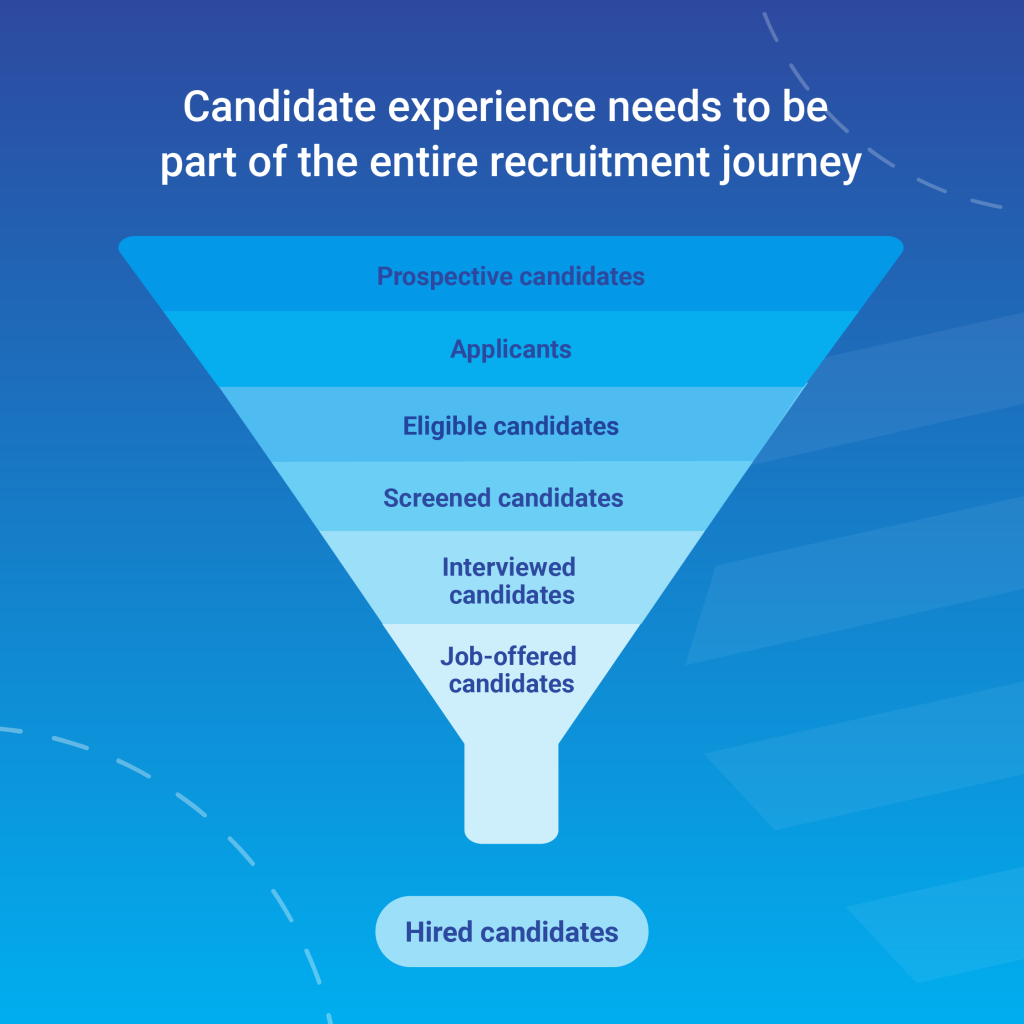
Candidate experience encompasses every interaction between a candidate and an organization throughout the recruiting and hiring process, spanning various channels such as social, digital, in-person, and experiential.
This extends from the pre-application stage to the various stages of the recruitment process, ultimately shaping the candidate’s perception of fairness and influencing measurable attitudes and behaviors. The resulting sentiment and perception of fairness significantly impact whether the job seeker will consider reapplying, referring others, developing brand affinity, making purchases, or influencing purchasing decisions.
Let’s dive into best practices that will enhance candidate experience.
Example 1: Scrap the CV for entry-level roles
An exceptional candidate experience involves tailoring the recruitment process to the specific needs of the role. This may necessitate a re-evaluation of your current approach, especially if you rely on CVs, as they often fail to predict a candidate’s success in certain roles.
Enhancing candidate experience by saving time and effort
Implementing a streamlined application process, particularly for entry-level roles, can significantly improve the candidate experience. By eliminating the requirement for CV submission, you simplify the application procedure and set your company apart from others in the industry. This innovative approach expresses a desire to judge candidates on their skills and potential rather than experience or education. It aligns with the evolving recruitment landscape, emphasizing a candidate-centric experience and differentiating your organization in the competitive hiring landscape.
Overcoming unconscious bias
Moreover, CV screening is susceptible to unconscious bias, as resumes often contain information that inadvertently triggers biases in recruiters or hiring managers. Unconscious biases, such as those related to a candidate’s name, gender, ethnicity, or school attended, can lead to unintentional and unfair judgments during the review process.
Example 2: Reduce Candidate Dropouts with Realistic Job Assessments
On average, 80% of frontline job applicants will not make it to the end of the recruitment process. They’ll take other jobs, be unsuitable, or decide it’s not the right role, typically after you’ve invested time in them as a candidate. Using Realistic Job Assessments to assess a candidate’s job suitability as well as to communicate the realities of the job can reduce your candidate dropout rates by 50% or more.
Fast and interactive experience with Realistic Job Preview
Applicants gain a rapid, interactive preview of the job’s reality, allowing them to self-opt out if the role isn’t a good fit. This proactive approach reduces employee turnover, particularly when the job involves physically demanding tasks. For instance, if the role requires standing for extended periods or lifting heavy weights, informing candidates upfront helps bridge the candidate expectation gap. This transparency streamlines downstream processes by addressing potential concerns before they arise.
Avoiding Gamified and Abstract Assessments
Research shows that candidates prefer assessments that tell them about the job and actively dislike game-based or “abstract” assessments like personality tests. Realistic Job Assessments ensure a more genuine evaluation aligned with actual job demands, enhancing the overall candidate experience.
This approach not only fosters a more transparent and engaging candidate experience but also contributes to the organisation’s long-term success by minimizing dropouts and aligning candidate expectations with the realities of the job.
Example 3: Provide candidate feedback
“I find it puzzling why anyone would choose a career in recruitment without a genuine interest in leaving candidates in a better place than where they started. A few pieces of feedback can truly alter the course of someone’s career, opening doors that could change their life.” – Kevin Grossman, Candidate Experience, How to improve talent acquisition to drive business performance.
In high-volume recruitment, receiving thousands of applicants for a single role makes it impractical for recruiters or hiring managers to provide personalized feedback to all applicants. However, by incorporating online assessments, such as those described in example two, you can offer candidates an open and helpful feedback loop.
Many of ThriveMap’s clients opt for instant feedback as part of the assessment process if candidates don’t meet the hiring criteria. For instance, feedback might include details like the candidate’s commute is out of range. This immediate feedback not only provides transparency but also aids candidates in understanding the specific reasons for their outcomes.
In cases where candidates seek more details about acceptance or rejection after the assessment, the feedback email can extend beyond generic messages like “We experienced an unprecedented number of candidates applying for this role and invite you to apply in the future.” Leveraging their assessment results allows for a more in-depth and tailored explanation, enhancing the candidate experience.
Next steps:
These best practices form a comprehensive framework to streamline your recruitment processes and prioritize enhancing the candidate experience. By embracing these practices, you can effectively navigate the challenges of high-volume recruitment, creating a positive and impactful journey for candidates and ultimately contributing to the organisation’s long-term success.
Interested to see how ThriveMap can enhance your candidate experience? Request a demonstration here.
Learn more about what candidates like here.
Read research about the candidate expectation gap here.
Learn how to ask for and get candidate testimonials in this step-by-step blog post
Keep reading.
Candidate experience
72% of Candidates Say They’ve Been “Job Catfished”
What is ‘job catfishing’ “Job catfishing” describes a specific hiring failure: when the lived reality of a role materially differs from what a candidate expected when they accepted the offer. It’s not about ghosting. It’s not about poor communication during interviews. In fact, most candidates report that information during the hiring process is broadly consistent. […]
Candidate experience
The Candidate Expectation Gap: Why Filtering Faster Is Not the Same as Hiring Better
Why Most Hiring Systems Measure the Wrong Things Modern hiring processes are built to move people through a funnel. Applications in. Screens out. Interviews. Offer. Start date. Most of the metrics that define success sit at the top of that funnel. Speed to hire. Time to shortlist. Cost per hire. Interview to offer ratio. Those […]
Candidate experience
Try This Candidate Testimonial Template & Get Rave Hiring Reviews
Imagine this: A potential candidate is browsing your company’s career page, intrigued by the career opportunities and the culture you’re promoting. They’re impressed by what they see, but they’re worried that the hiring process is going to be long and cumbersome. Before applying for a job, they need something more convincing: powerful candidate testimonials. Let’s […]