Work sample assessments: why they outperform traditional hiring methods
Most hiring assessments try to predict performance.
Work sample assessments don’t predict it.
They observe it directly.
And the data is increasingly clear: candidates trust them more, see them as fairer, and perform better when they’re used properly.
What is a work sample assessment?
A work sample assessment is a hiring method where candidates complete tasks that closely reflect the actual job.
Instead of answering abstract questions or personality tests, candidates are asked to:
- handle realistic scenarios
- complete job-relevant tasks
- demonstrate how they would perform in role
Examples include:
- responding to a frustrated customer (contact centre)
- prioritising tasks under time pressure
- reviewing and fixing real-world problems
The goal is simple:
? simulate the job before someone is hired into it
Why work sample assessments outperform other methods
Most hiring processes optimise for signals:
- CVs
- past job titles
- interview performance
But these are indirect indicators of performance.
Work samples measure actual behaviour.
And candidates recognise that.
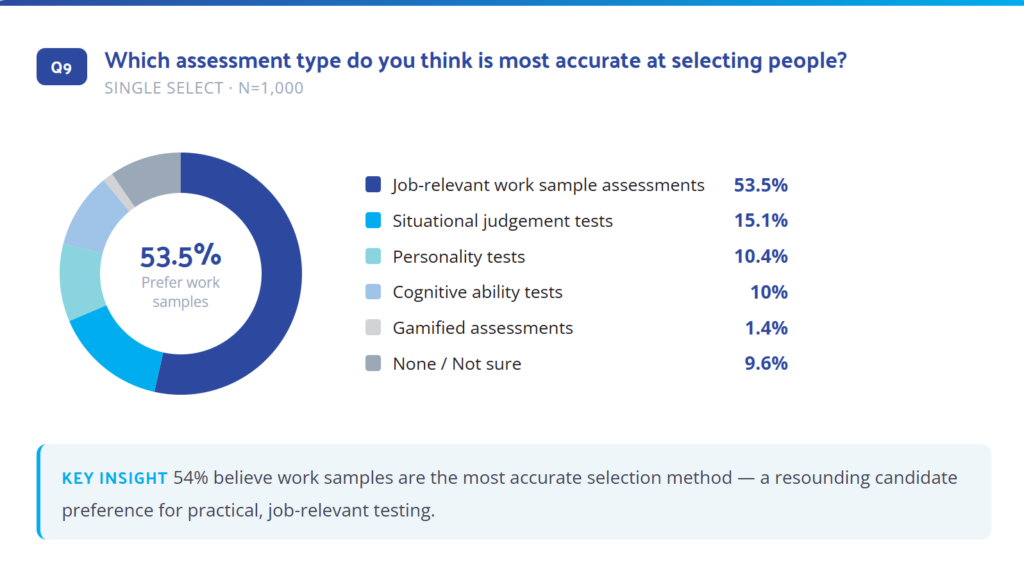
1. Candidates believe work samples are the most accurate
According to the State of the Assessment Market Report 2026:
- 53.5% of candidates say work samples are the most accurate way to assess someone
- compared to:
- 15.1% for situational judgement tests
- 10.4% for personality tests
- 10% for cognitive ability tests
That’s not a marginal preference. It’s a dominant one.
2. They’re also seen as the fairest method
Fairness is a major issue in hiring, especially with increasing scrutiny on bias and AI.
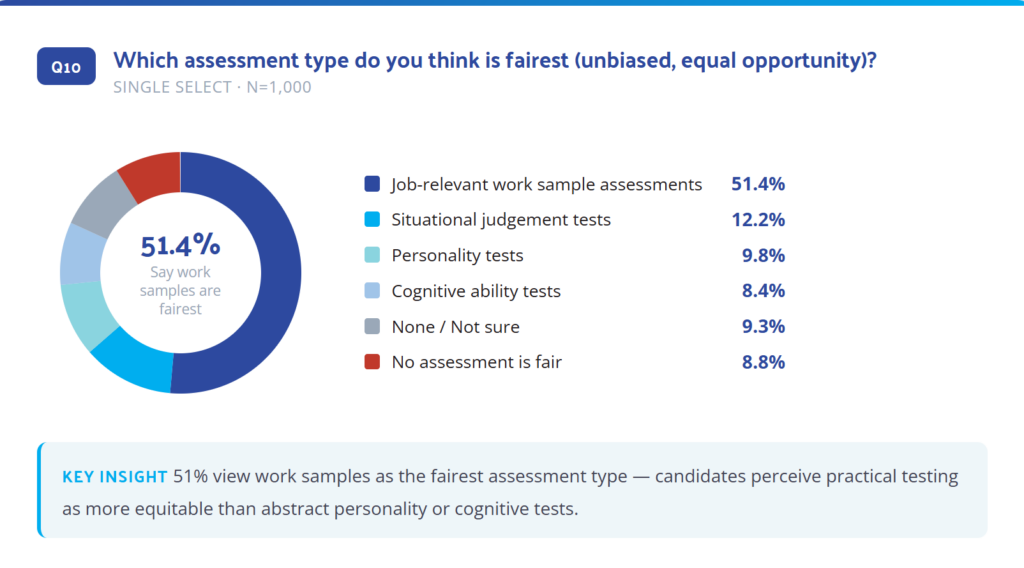
The same report found:
- 51.4% of candidates say work samples are the fairest assessment type
- far ahead of any alternative
This matters because perceived fairness impacts:
- candidate trust
- acceptance rates
- employer brand
3. They increase candidate confidence before accepting a role
One of the biggest problems in hiring is misalignment between expectation and reality.
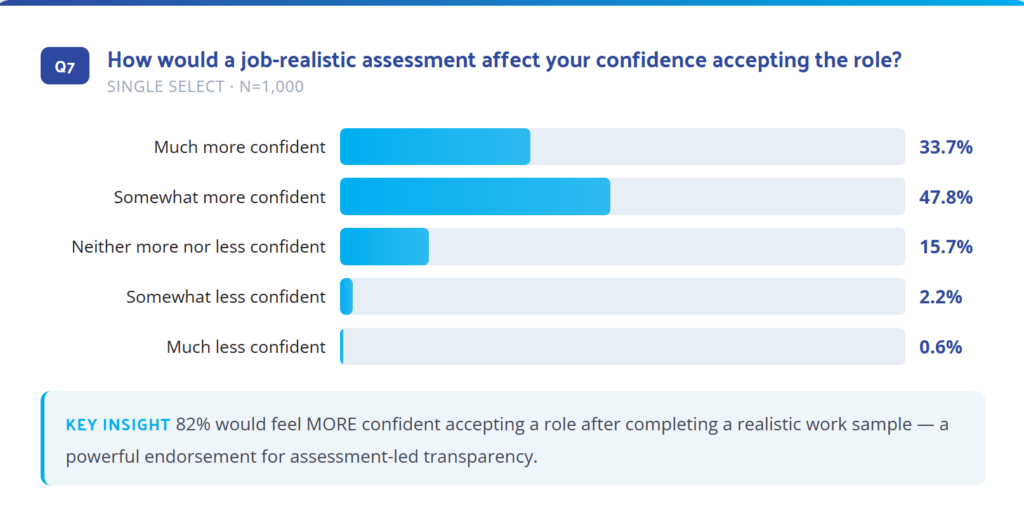
The data is stark:
- 82% of candidates say they would feel more confident accepting a role after completing a realistic work sample
- 33.7% much more confident
- 47.8% somewhat more confident
This is critical.
Because low confidence leads to:
- dropouts before start
- early attrition
- disengagement
The real problem: hiring without job realism
Most hiring processes fail to show candidates what the job is actually like.
Instead, they rely on:
- job descriptions
- interviews
- generic assessments
But candidates themselves say this isn’t enough.
When asked what would have helped them understand a role before accepting:
- 48.3% wanted more honest information about workload and pressure
- 30.7% wanted clearer expectations
- 29% wanted a “day in the life” preview
- 16.5% wanted a realistic task or work sample
That gap is where hiring breaks down.
Why this matters: the cost of getting it wrong
When hiring lacks realism:
- candidates accept roles they don’t fully understand
- expectations don’t match reality
- people leave early
This isn’t rare.
From the same report:
- 72% say they accepted a job that turned out to be misrepresented
- 66% have left a role because it wasn’t what they expected
Work sample assessments directly address this.
How work sample assessments improve hiring outcomes
1. Better job fit
You see how candidates actually perform, not how they present themselves.
2. Lower early attrition
Candidates self-select out when they experience the reality of the role.
That’s a feature, not a flaw.
3. Higher quality of hire
You prioritise people who can do the job and want the job.
4. More efficient screening
Instead of reviewing hundreds of CVs, you focus on a smaller, higher-quality group.
When to use work sample assessments
They are especially effective for:
- high volume hiring
- entry-level roles
- contact centres and frontline roles
- roles with high early attrition
- roles where day-to-day reality is hard to communicate
Best practices for work sample assessments
To be effective, work samples need to be:
1. Job-relevant
They should reflect real tasks, not abstract exercises.
2. Realistic
Include real constraints:
- time pressure
- ambiguity
- competing priorities
3. Transparent
Use them to educate candidates about the role, not just assess them.
4. Used early in the process
The biggest impact comes when they’re used before CV screening, not after.
Work sample assessments vs traditional hiring
| Method | What it measures | Limitation |
|---|---|---|
| CV screening | Experience | Misses capability and fit |
| Interviews | Communication | Subjective, inconsistent |
| Personality tests | Traits | Weak predictor of performance |
| Cognitive tests | Ability | Not job-specific |
| Work samples | Actual performance | Requires thoughtful design |
The shift toward assessment-led hiring
Hiring is moving from:
- signal-based decisions
→ to - evidence-based decisions
Work sample assessments are central to this shift.
They reduce guesswork and increase confidence on both sides.
Final thought
Most hiring processes try to infer who will succeed.
Work sample assessments show you.
And when candidates themselves say they are:
- more accurate
- fairer
- and increase confidence
…it’s not just a better candidate experience.
It’s a better hiring decision.
If you’re hiring for roles where early attrition is a problem, the question isn’t whether you assess candidates.
It’s how realistic that assessment is.
Keep reading.
Choosing a pre-hire assessment provider: what the new RecTech standard asks of them
UK RecTech vendors process more than 200 million job applications between them a year (Better Hiring Institute). That is the scale of what is riding on these tools actually working: whether the right people get shortlisted, and whether good candidates get screened out by something nobody has ever checked. The pressure on that volume is […]
How to avoid contrast bias in recruitment
Imagine your team spends a day sifting CVs. The first few are underwhelming. Then they open one that’s reasonably strong and, by comparison, it looks excellent. Or you’re interviewing six candidates in a day. The 10am candidate gives polished, detailed answers and sets an unusually high bar. The person who follows is perfectly capable, but […]
If AI can pass your hiring process, what are you actually assessing? Join live Equitas, ThriveMap and Morgan Philips Webinar
AI is changing both sides of recruitment at the same time. Candidates can use it to write CVs, improve applications, prepare interview answers and increasingly automate the application process itself. Employers are using AI to screen candidates, match people to roles and automate parts of selection. Some of this technology is genuinely useful. Some of […]