Most hiring teams are under pressure to improve time-to-fill.
That makes sense, open roles create real operational pain.
Traditional vs Realistic Recruitment
But speed doesn’t tell you whether the person who accepted the role will still be there in three weeks.
And when candidates aren’t a good fit, it shows through early attrition, retraining costs, frustrated managers, and leadership asking:
“Why can’t we just hire the right people?”
That’s where the difference between traditional and realistic recruitment becomes visible.
Traditional recruitment is designed to keep the process moving.
Realistic recruitment is designed to turn job-fit into a repeatable, evidence-based system.
And that difference impacts who stays, who leaves, and who thrives.
What traditional recruitment looks like:
In most organisations, hiring falls into a familiar rhythm.
First, CVs get scanned for the right experience and keywords.
Then come competency-based interviews.
Sometimes there’s a standard assessment in the mix.
At the end, a decision gets made based on scores, references, and gut feel.
There’s nothing inherently wrong with this. It’s efficient. It’s repeatable.
At its core, this kind of process is very good at answering one question:
“Can we move enough people through the system quickly and reliably?”
That’s valuable.
But it also shapes what decisions get based on. Instead of the realities of the role, they often lean on:
- Generic competency frameworks
- How well someone performs in an interview setting
- Standardised tools that get reused across very different jobs
All of that drives process efficiency, not necessarily commercial confidence.
And the side effect is subtle but important:
a lot of the job itself stays imagined rather than experienced.
Candidates hear about the role. They rarely get to see it.
So they fill in the gaps themselves, usually in the most optimistic way possible.
What realistic recruitment does differently
Realistic recruitment starts with a simple, practical idea.
If someone is going to spend most of their week doing a job, they deserve a clear, honest sense of what that work actually feels like before they say yes.
So instead of keeping the role at arm’s length, parts of the real job get pulled into the hiring process. Things like:
- The kinds of decisions people actually make on a normal day
- The trade-offs they have to navigate
- The pace, pressure, or ambiguity that comes with the work when things aren’t going smoothly
Rather than asking, “Would this person fit our culture?”
It asks something more grounded:
“Would this person still want this job if they saw it up close?”
And the impact of realistic recruitment has tangible benefits.
When candidates see the reality of a role early, two patterns tend to follow:
- Fewer people leave because “this isn’t what I thought I was signing up for”
- Hiring managers spend less time reopening the same role a few months later
Both of those improve 90-day retention and reduce repeat hiring for the same positions.
The difference between traditional and realistic hiring:
| Approach | Traditional Recruitment | Realistic Recruitment |
|---|---|---|
| Primary goal | Move candidates through the process efficiently | Help candidates and hiring teams make a well-informed decision |
| Design focus | Standardisation and consistency | Role-specific clarity and relevance |
| What candidates experience | Job descriptions and competency-based interviews | Real tasks, scenarios, and everyday challenges |
| What hiring teams rely on | Scores, CV signals, and interview impressions | Evidence from job-like situations and observed behaviour |
| Predictive value | Moderate for performance in the role | Higher for performance and retention |
| Impact on early attrition | Indirect, often reactive | Direct, via expectation-setting and self-selection |
| Decision explainability | Score- and framework-based | Evidence- and job-based |
| Bias and fairness control | Depends heavily on interviewer consistency | Anchored to role-relevant criteria and scenarios |
| Scalability | High, with generic frameworks | High, with structured role frameworks |
| Typical risk | “Great on paper” hires that struggle in practice | Requires more upfront investment, fewer surprises later |
Where mismatches usually start
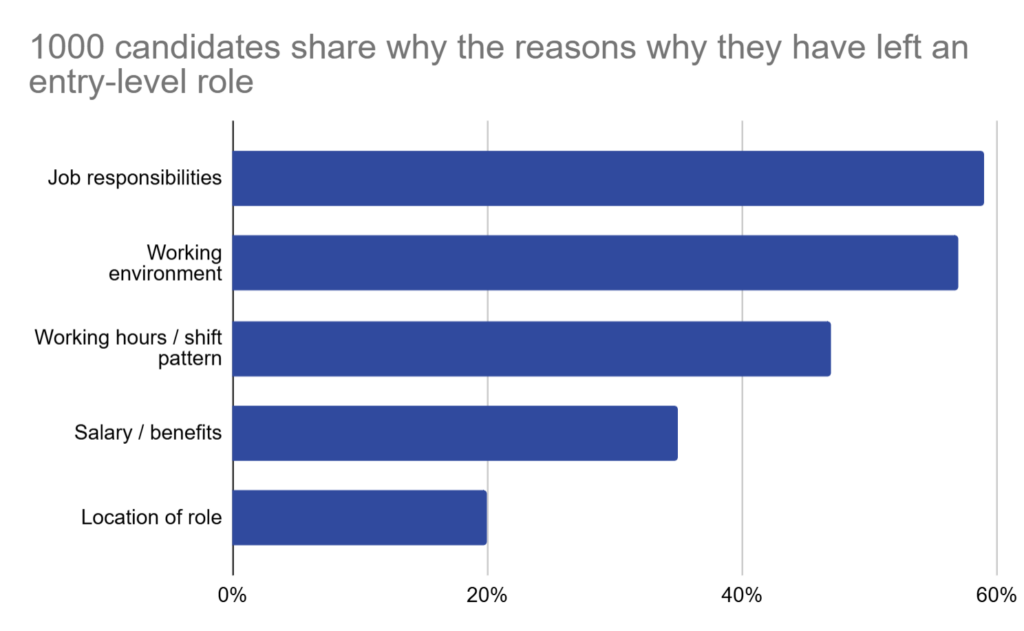
Most early leavers don’t quit because they can’t do the job.
They leave because:
- The pace is different than they expected
- The role is not the same as they imagined
- The environment isn’t what they pictured from the interview
None of that shows up clearly in a CV.
And it rarely shows up in a competency question either.
It shows up in the work itself.
Why realistic recruitment is better for candidates
From the candidate side, traditional hiring can feel like a guessing game.
They try to work out:
- What a “typical day” actually looks like
- What success really means in this role
- What people struggle with once they’re in
Realistic recruitment makes that visible. And when candidates can see the job more clearly, two useful things happen:
- Some people lean in, because it’s exactly what they want
- Others step back, because it isn’t
Both outcomes save everyone time, energy, and awkward conversations later.
Why realistic recuitment is essential for high volume and entry-level hiring
High-volume hiring is often treated as a numbers game.
More applicants. Faster screening. Shorter time-to-fill.
But entry-level, frontline, graduate, and seasonal roles are exactly where CVs and generic criteria are least predictive.
Most candidates in these roles look similar on paper.
What actually determines success is how they handle:
- Pace and pressure on a normal shift
- Shift patterns (Yes – 20% of entry-level new recruits have left a job because the shift pattern was different to what they assumed)
- Repetition and routine
- Customer or operational friction
- Working patterns, environments, and physical or cognitive demands
When those realities aren’t visible in the hiring process, people accept roles based on assumptions, and those assumptions are usually optimistic.
High-volume environments often experience high early attrition when using traditional recruitment approaches because the job isn’t what they thought they were signing up for.
Realistic recruitment changes that dynamic. It brings the work itself into the decision for both sides before an offer ever goes out.
What this looks like in practice
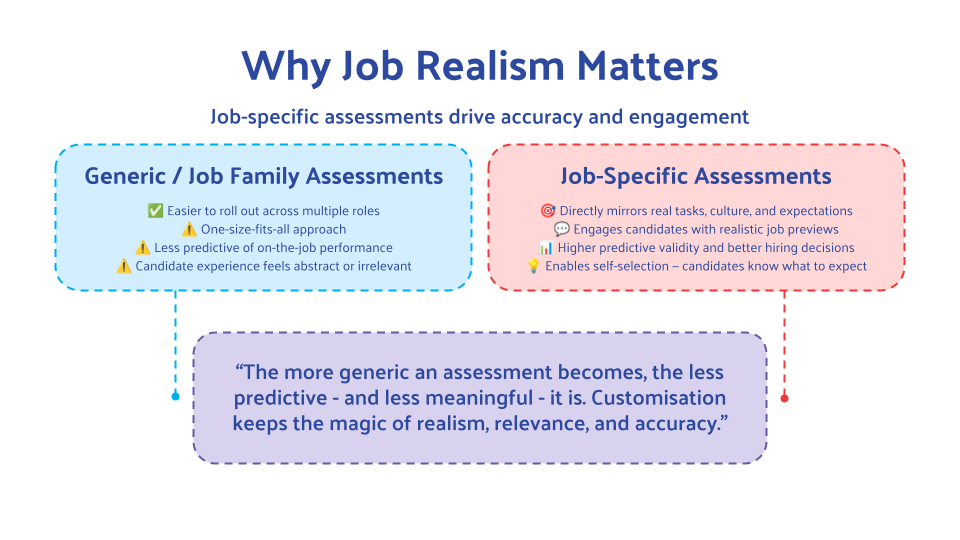
Instead of relying on CVs, generic assessments, or surface-level interviews, realistic recruitment uses job-specific scenarios and evidence-based criteria to show candidates:
- What a typical day actually involves
- The kinds of decisions they’ll be making
- Where people usually struggle — and where they tend to thrive
The commercial impact is simple:
- Fewer people accept roles they’re likely to leave quickly
- Hiring managers spend less time reopening the same roles
How to introduce realism into your recruitment process at scale
Most organisations start where the attrition and volume hurt most, so frontline, early careers, and seasonal roles.
That often looks like:
- Replacing generic screening with job-realistic assessments
- Building role criteria from how current employees actually succeed
- Using scenarios that reflect real shifts, real customers, and real operational trade-offs
- Capturing clear, job-based evidence for every hiring decision
This is where specialist providers come in.
Teams using job-realistic assessment platforms have been able to roll this approach out across thousands of hires without losing consistency or speed — particularly in high-volume, early-career, and frontline roles.
Organisations like Mitie, Wincanton, Berkeley Group, and Higgs LLP have used this model to improve hiring accuracy, reduce early attrition, and give candidates a clearer picture of what the job really involves before day one.
Keep reading.
General
Choosing a pre-hire assessment provider: what the new RecTech standard asks of them
UK RecTech vendors process more than 200 million job applications between them a year (Better Hiring Institute). That is the scale of what is riding on these tools actually working: whether the right people get shortlisted, and whether good candidates get screened out by something nobody has ever checked. The pressure on that volume is […]
General
How to avoid contrast bias in recruitment
Imagine your team spends a day sifting CVs. The first few are underwhelming. Then they open one that’s reasonably strong and, by comparison, it looks excellent. Or you’re interviewing six candidates in a day. The 10am candidate gives polished, detailed answers and sets an unusually high bar. The person who follows is perfectly capable, but […]
General
If AI can pass your hiring process, what are you actually assessing? Join live Equitas, ThriveMap and Morgan Philips Webinar
AI is changing both sides of recruitment at the same time. Candidates can use it to write CVs, improve applications, prepare interview answers and increasingly automate the application process itself. Employers are using AI to screen candidates, match people to roles and automate parts of selection. Some of this technology is genuinely useful. Some of […]