What 200,000+ candidate journeys reveal about how hiring performance changes across sectors
Pre-hire assessment completion rates & candidate drop-off by industry
Why do candidates complete nearly every assessment in some industries — but never even start them in others?
At first glance, the explanation seems obvious. Different sectors have different candidates, different expectations, or different hiring challenges.
But analysis of more than 200,000 pre-hire assessment journeys suggests something more revealing.
Across this dataset, every employer used a ThriveMap realistic job assessment, meaning differences in outcomes cannot be attributed to variation in assessment design or experience quality.
ThriveMap assessments are built to simulate the realities of the role itself — showing candidates what work actually involves before interview. This matters because most hiring assessments still focus purely on screening ability rather than helping candidates understand the job they are applying for.
Yet completion outcomes still varied dramatically by industry.
As Recruiting Brainfood analyst Hung Lee observed when reviewing the findings:
I’m not sure if we’ve ever seen sectoral segmentation on this type of data before; it’s fascinating and important to see how candidate behaviour on the assessment journey varies by industry. Important work here by Thrivemap – all recruiters should dig in.
This distinction is important. Industry differences persist even when assessment quality is controlled — suggesting that candidate behaviour is shaped less by assessment difficulty and more by how clearly candidates understand the role they are committing to.
Separate research in this report shows that fewer than 5% of organisations currently use assessments to educate candidates about the realities of the job itself. Most assessments still act purely as filters.
ThriveMap takes a different approach: using realistic job assessments to allow candidates to self-select in or out based on informed understanding.
What sectoral segmentation reveals here is not simply assessment performance — but differences in candidate commitment before the assessment even begins.
Assessment start & completion benchmarks by industry
| Industry | Start Rate | Completion Rate | Drop-Off |
|---|---|---|---|
| Utilities & Energy | 97.4% | 99.3% | 0.7% |
| Facilities Management & Public Services | 89.4% | 93.1% | 6.9% |
| Engineering, Rail & Industrial Technology | 82.9% | 96.1% | 3.9% |
| Transport & Public Transit | 78.7% | 91.8% | 8.2% |
| Real Estate & Property Development | 78.1% | 94.8% | 5.2% |
| Telecommunications & Technology Services | 79.7% | 88.8% | 11.2% |
| Logistics & Supply Chain | 76.3% | 91.1% | 8.9% |
| Financial Services & Consumer Lending | 66.2% | 84.2% | 15.8% |
| Environmental Services & Waste Management | 63.5% | 76.5% | 23.5% |
| Veterinary & Animal Care | 50.0% | 65.2% | 34.8% |
The most striking differences appear not in completion — but in whether candidates start assessments at all.
Utilities candidates almost universally begin the process. In veterinary and some service-adjacent sectors, half of invited candidates never enter the assessment environment.
Because the assessment itself is consistent, these differences cannot be explained by assessment quality.
They reflect something upstream.
The real divide happens before assessment
Once candidates start an assessment, completion rates converge significantly across industries.
This suggests a critical shift in interpretation:
The primary point of candidate loss is not assessment difficulty or length — it is initial commitment.
Candidates appear to make an early decision about whether a role is worth pursuing before engaging with evaluation.
The assessment does not create motivation — it clarifies commitment.
When candidates experience realistic previews of day-to-day work, they can make informed decisions earlier in the hiring journey. Those who continue are doing so with clearer expectations about the role itself.
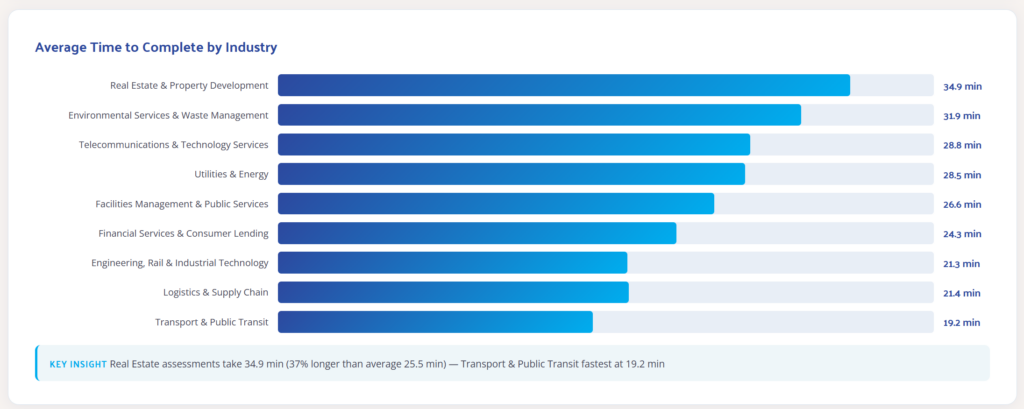
Average assessment completion time by industry
| Industry | Average Time to Complete |
|---|---|
| Real Estate & Property Development | 34.9 mins |
| Environmental Services & Waste Management | 31.9 mins |
| Telecommunications & Technology Services | 28.8 mins |
| Utilities & Energy | 28.5 mins |
| Facilities Management & Public Services | 26.6 mins |
| Financial Services & Consumer Lending | 24.3 mins |
| Engineering, Rail & Industrial Technology | 21.3 mins |
| Logistics & Supply Chain | 21.4 mins |
| Transport & Public Transit | 19.2 mins |
Assessment duration varies by nearly 16 minutes between industries.
Longer assessments are tolerated when candidates perceive strong career value or stability. Where alternative opportunities are abundant, time becomes friction.
Assessment length, therefore, cannot be optimised in isolation — it must be calibrated against sector expectations.
This highlights an often-overlooked dynamic: candidates are willing to invest time when the assessment helps them understand what success in the role actually looks like.
Realistic assessments reduce uncertainty. Rather than asking candidates to complete abstract tests, they provide evidence of what the job involves — allowing candidates to decide whether the opportunity genuinely fits their expectations.
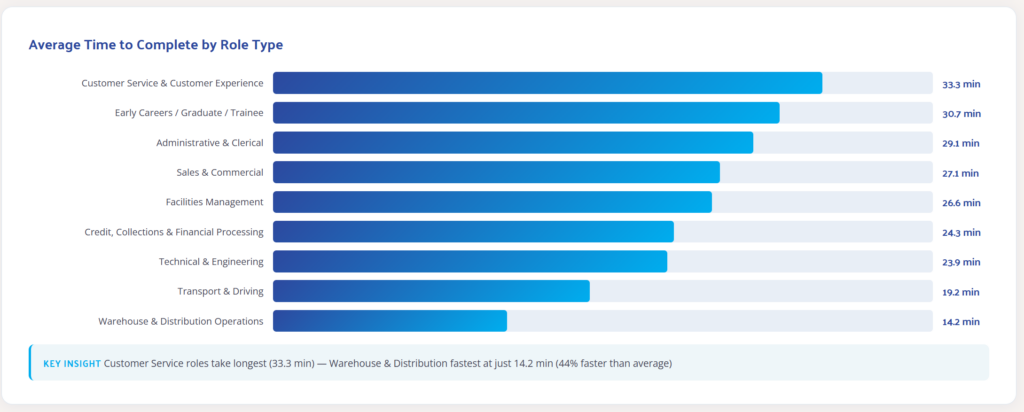
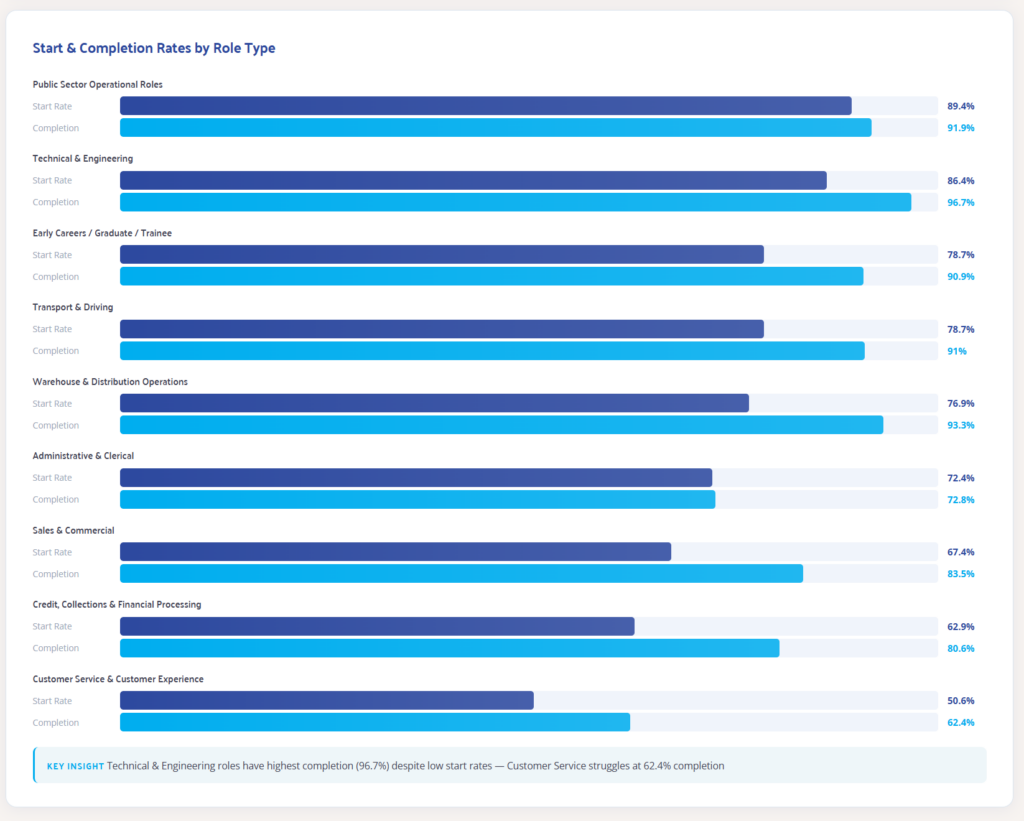
Completion behaviour by role type
| Role Type | Start Rate | Completion Rate |
|---|---|---|
| Public Sector Operational | 89.4% | 91.9% |
| Technical & Engineering | 86.4% | 96.7% |
| Early Careers / Graduate | 78.7% | 90.9% |
| Transport & Driving | 78.7% | 91.0% |
| Warehouse & Distribution | 76.9% | 93.3% |
| Administrative & Clerical | 72.4% | 72.8% |
| Sales & Commercial | 67.4% | 83.5% |
| Credit & Financial Processing | 62.9% | 80.6% |
| Customer Service & Experience | 50.6% | 62.4% |
Role type mirrors the same pattern seen across industries: structured or specialised roles show strong engagement once candidates enter the process, while high-volume customer-facing hiring experiences greater early disengagement.
What sector segmentation actually reveals
Because assessment experience is standardised, industry differences expose variations in how candidates apply for jobs.
Some labour markets attract deliberate applicants who research roles and expect structured selection processes.
Others attract exploratory applicants applying to multiple opportunities simultaneously, committing later — or not at all.
Sector benchmarking therefore reveals differences in applicant intent rather than assessment effectiveness.
A shift in how assessment performance should be understood
Traditionally, hiring teams evaluate assessments as if candidate engagement develops during the hiring process.
This data suggests the opposite.
Candidate commitment is largely formed before assessment interaction begins.
Pre-hire assessments function less as engagement tools and more as commitment checkpoints — identifying candidates already prepared to invest effort in the opportunity.
Preventing job catfishing in hiring
One emerging risk in modern hiring is what ThriveMap describes as job catfishing — where candidates accept roles based on incomplete or overly optimistic job information, only to discover mismatches after joining.
Traditional assessments rarely address this problem because they evaluate candidates without revealing the realities of the role.
Realistic job assessments change that dynamic by aligning expectations early, enabling informed opt-out before hire rather than regret after onboarding.
(See our analysis on job catfishing and realistic hiring previews
The bigger implication for hiring teams
Industry benchmarking remains critical, but not because sectors require fundamentally different assessments.
Instead, sector context influences candidate certainty at the point of application.
Organisations interpreting completion rates without this context risk diagnosing the wrong problem — optimising assessment design when the underlying issue may sit earlier in the hiring journey.
The emerging lesson is simple:
Candidates rarely abandon assessments at random.
Most decide whether to continue long before the first question appears.
And when hiring experiences are grounded in realistic job previews, those decisions become intentional.
The role of pre-hire assessment is shifting — from filtering candidates to helping both sides understand the work itself.
In that sense, completion rate is no longer just a hiring metric. It becomes a signal that candidates are entering roles with clearer expectations, stronger alignment, and a lower risk of mismatch.
Keep reading.
General
Choosing a pre-hire assessment provider: what the new RecTech standard asks of them
UK RecTech vendors process more than 200 million job applications between them a year (Better Hiring Institute). That is the scale of what is riding on these tools actually working: whether the right people get shortlisted, and whether good candidates get screened out by something nobody has ever checked. The pressure on that volume is […]
General
How to avoid contrast bias in recruitment
Imagine your team spends a day sifting CVs. The first few are underwhelming. Then they open one that’s reasonably strong and, by comparison, it looks excellent. Or you’re interviewing six candidates in a day. The 10am candidate gives polished, detailed answers and sets an unusually high bar. The person who follows is perfectly capable, but […]
General
If AI can pass your hiring process, what are you actually assessing? Join live Equitas, ThriveMap and Morgan Philips Webinar
AI is changing both sides of recruitment at the same time. Candidates can use it to write CVs, improve applications, prepare interview answers and increasingly automate the application process itself. Employers are using AI to screen candidates, match people to roles and automate parts of selection. Some of this technology is genuinely useful. Some of […]