Candid feedback often surfaces on platforms like Glassdoor, where candidates freely share their experiential discontent.
2023 guide to what frontline candidates expect from pre-hire processes
Some of these reviews can carry a real sting.

You can’t always please everyone. But it is important to be able to identify potential vulnerabilities within your pre-hire process to avoid unfavourable reviews that could potentially tarnish your company’s reputation.
What might be your company’s internal processes, may be off-putting for candidates and giving them a negative impression of the business.
So, we were curious – what do frontline candidate expect from recruitment processes in 2023
Harnessing the power of AI, we analysed 100’s of negative Glassdoor reviews for frontline roles such as those in hospitality, customer service, and fast-food, to understand what exactly fuels dissatisfaction.
Here’s the top 5 issues we uncovered.
 Candidates seem to value speed above all. Instances where interview procedures prove excessively lengthy or intricate in relation to the job’s nature seems to breed the most frustration.

Lack of follow-up not only leaves candidates in the dark about their application status but also sends a message that their time and effort aren’t valued.

Requiring extensive CVs, lengthy assessments, and detailed covering letters can frustrate candidates who seek a streamlined and efficient application process. The frustration stemming from cumbersome paperwork leads potential hires to question whether the administrative burden reflects the actual nature of the job.
4. Expectation misalignment:

In the world of frontline roles, where agility and adaptability are key, many candidates expressed frustration when facing interview questions that seem out of sync with the entry-level nature of the position. Redundant queries about prior experiences can lead to a mismatch between candidate expectations and the actual responsibilities of the role. This misalignment not only disengages potential candidates but also indicates a potential communication gap between the recruitment process and the role’s true demands.
5. Predictable questions that aren’t relevant:
When it comes to making a lasting impression, the questions posed during interviews wield considerable influence.
Interestingly, candidates often point out their dissatisfaction with commonplace and predictable interview questions. This insight suggests a desire for thought-provoking questions that not only challenge candidates but also provide them with the opportunity to showcase their unique qualities.
Need to revamp your pre-hiring procedure?
When it comes to selecting candidates for frontline positions, the inner workings of your process often remain hidden from their view. Coordinating interviews, evaluating resumes, and securing approval from hiring managers all happen behind the scenes.
Nevertheless, the candidate experience holds greater significance than ever before. If you find your process to be cumbersome and ineffective, chances are your candidates share that sentiment—even if they haven’t voiced their concerns on platforms like Glassdoor just yet.
In response, numerous businesses are turning to Realistic Job Assessments as a new approach to their pre-hire evaluations, especially for roles where traditional methods such as CV reviews, phone screenings, and game-based assessments are no longer as relevant. Realistic Job Assessments have demonstrated improvements in hiring diversity, reduced time-to-hire, and enhanced on-the-job performance. This, in turn, leads to lower turnover rates and more positive feedback about the hiring process.
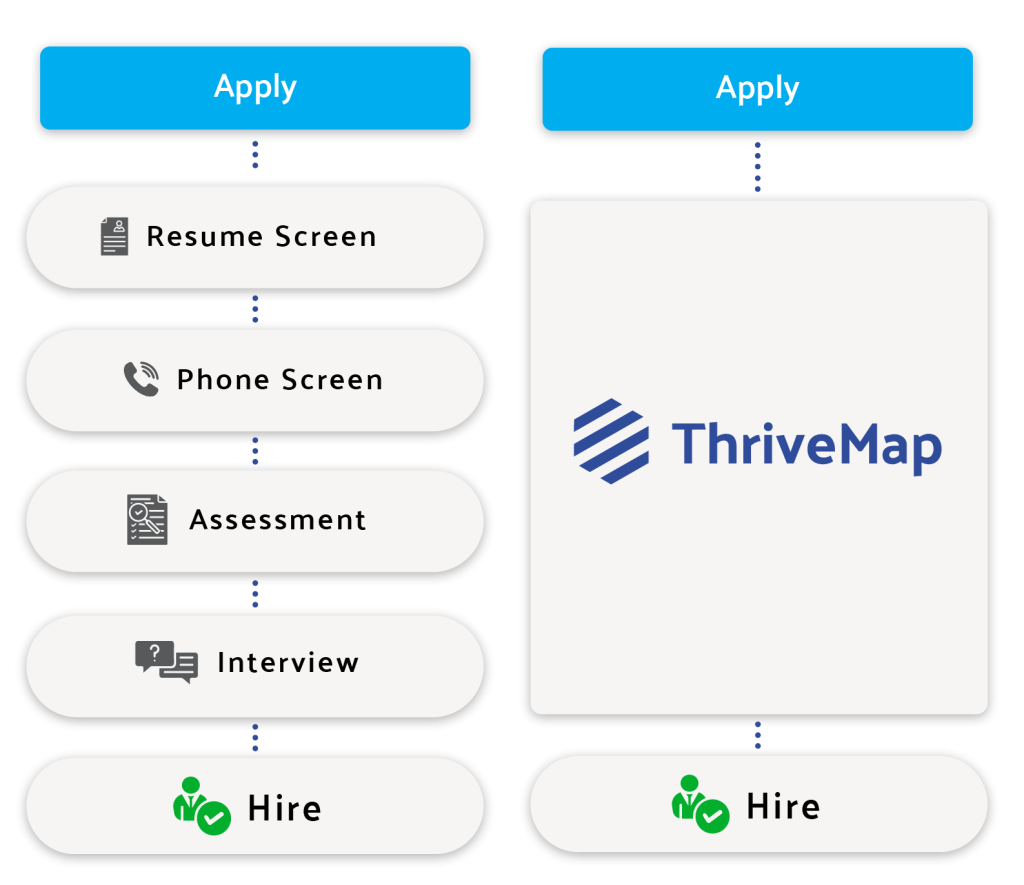
Read more on Realistic Job Assessments here: thrivemap.io/realistic-job-assessment/
Keep reading.
General
Choosing a pre-hire assessment provider: what the new RecTech standard asks of them
UK RecTech vendors process more than 200 million job applications between them a year (Better Hiring Institute). That is the scale of what is riding on these tools actually working: whether the right people get shortlisted, and whether good candidates get screened out by something nobody has ever checked. The pressure on that volume is […]
General
How to avoid contrast bias in recruitment
Imagine your team spends a day sifting CVs. The first few are underwhelming. Then they open one that’s reasonably strong and, by comparison, it looks excellent. Or you’re interviewing six candidates in a day. The 10am candidate gives polished, detailed answers and sets an unusually high bar. The person who follows is perfectly capable, but […]
General
If AI can pass your hiring process, what are you actually assessing? Join live Equitas, ThriveMap and Morgan Philips Webinar
AI is changing both sides of recruitment at the same time. Candidates can use it to write CVs, improve applications, prepare interview answers and increasingly automate the application process itself. Employers are using AI to screen candidates, match people to roles and automate parts of selection. Some of this technology is genuinely useful. Some of […]